
H1B Visa USA: Apply from Philippines
The H1B visa is the principal route through which US employers hire foreign professionals for specialty occupations. It is one of the most closely followed visa categories among Filipino professionals working in technology, engineering, healthcare, and finance.
Total Law’s immigration attorneys advise both US employers and Filipino professionals on H1B sponsorship, from the annual lottery registration through to visa stamping at the US Embassy in Manila and, in later years, extension or adjustment to permanent residence. Contact our team online or at +1 844 312 4979 to discuss your H1B visa application or sponsorship strategy.
What is an H-1B Visa in the US?
The H1B visa allows a US employer to temporarily employ a foreign national in a specialty occupation. This means a job that typically requires at least a bachelor’s degree in a specific field, along with the specialized knowledge that comes with it.
The category is a key part of the US skilled labor system and is used extensively across information technology, engineering, finance, healthcare, and academic and research institutions.
Qualifying for an H-1 B visa is based on two elements. The job itself must meet the legal definition of a specialty occupation, and the person filling it must hold the required degree or a recognized equivalent combination of education and experience.
A US employer must also sponsor the petition, as a worker cannot file for an H-1 B visa on their own.
Page Contents
- What is an H-1B Visa in the US?
- US H1B Visa Requirements for Filipino Citizens
- How to Apply for a US H1B Visa from the Philippines?
- H1B Visa US Costs and Fees
- Specialty Occupations Under the H-1B Visa
- Employment Guidelines for H-1B Visa Holders
- Duration of Status for H-1B Visa Holders
- H-1B Visa Stamping from the Philippines
- Compliance Considerations for Sponsoring Employers
- How Can Total Law Help?
- Frequently Asked Questions
The benefits of H1B status are considerable for a qualifying applicant. Unlike most other temporary work categories, the H1B allows dual intent, meaning a worker can hold H1B status while also pursuing a Green Card, without that being held against them as evidence they do not plan to leave when their status ends.
Spouses and unmarried children under 21 can accompany the principal applicant in H-4 dependent status, and certain H-4 spouses can apply separately for work authorization.
The category has an annual cap that is consistently oversubscribed. Because of this, most new applicants first go through a lottery, and simply qualifying for the visa is not enough. They also need to be selected before they can even submit a full petition.
USCIS receives several hundred thousand electronic registrations each cap season, for a combined total of 85,000 available slots.
The cap has been reached within days of the registration window opening nearly every year since the current registration system was introduced in 2020, and the underlying pattern of demand outstripping supply goes back considerably further still.
The Philippines has historically ranked among the source countries with meaningful, though smaller, H-1 B representation compared to India and China, concentrated heavily in healthcare, engineering, and information technology roles.
Filipino nurses, in particular, have strong ties to the H-1 B program, given the size of the Filipino nursing workforce already present in the United States, though nursing roles face a more demanding path to specialty occupation classification than many other professions.
The H-1 B visa allows employers to access a global talent pool for roles they cannot fill domestically, but in exchange, they must commit to a wage and compliance framework that carries real legal risk if not followed correctly.
Applicants gain lawful entry into skilled employment in the United States and the ability to pursue a green card simultaneously, without one undermining the other.
That dual-intent feature is one of the main reasons the H-1 B remains the preferred route for professionals with long-term plans in the United States, even amid the uncertainty the annual lottery brings.
"I'm very happy with the standard of training received on the OISC Level 1 course, i passed my exam. Thank you!"
Liam Calvert
Posted 6 years ago
"My application was approved and a huge weight has been lifted from our shoulders this year "
Akeel Lakar
Posted 6 years ago
"We used this service for the spouse visa extension application to assure that all the information was valid and correct."
Nabil Anwar
Posted 6 years ago
US H1B Visa Requirements for Filipino Citizens
Eligibility for H1B classification depends on both the job and the person filling it. The employer has to show that the role qualifies as a specialty occupation, and must file a Labor Condition Application with the Department of Labor confirming it will pay at least the required wage for that job in that location, whichever is higher: the official prevailing wage, or what the employer actually pays similar workers.
The individual has to hold a bachelor’s degree or higher in a field directly related to the job. If that degree was earned outside the United States, it needs to be evaluated for equivalency to a US degree. Applicants without a directly matching degree can sometimes qualify instead through a combination of specialized training and relevant work experience.

How to Apply for a US H1B Visa from the Philippines?
The application process proceeds through the following stages for most petitions:
- The employer files a Labor Condition Application (Form ETA-9035) with the Department of Labor, confirming the wage and working conditions offered for the role.
- If the position is subject to the annual cap, the employer submits an electronic registration for the candidate during the designated registration window, typically in March.
- USCIS runs the selection process. Registrants who are selected become eligible to file a full petition; those who are not selected must wait until the next cap season or seek a cap-exempt alternative.
- The employer files Form I-129, Petition for a Nonimmigrant Worker, along with the certified Labor Condition Application and evidence showing the job qualifies as a specialty occupation and that the worker meets its requirements.
- USCIS reviews the petition and may request additional evidence before making a decision.
- If approved and the worker is outside the United States, the worker completes Form DS-160 and attends a visa interview at a US embassy or consulate. A worker already in the United States in another valid status may instead request a change of status.
Recent changes affect this process directly. Beginning with the FY2027 cap season, USCIS replaced the old random lottery with a wage-weighted selection system. Higher-paying job offers now get more entries in the selection pool, based on the Department of Labor’s four wage levels, with the highest wage level receiving the most entries and the best odds of selection.
A presidential proclamation issued in September 2025 introduced a supplemental fee of $100,000 for new H1B petitions filed for workers outside the United States who require consular processing. This fee does not apply to most extensions, amendments, or change-of-status petitions filed for workers already present in the United States.
A federal court found the fee unlawful in June 2026. The government sought a stay of that ruling while it pursues an appeal, but the Court of Appeals for the First Circuit denied the stay request in late July 2026, meaning the fee is not currently being enforced.
The underlying appeal is still pending, and the proclamation authorizing the fee is itself due to expire in September 2026 unless renewed, so this remains an unsettled, fast-moving area. Employers and applicants should confirm the current position directly with USCIS or immigration counsel before assuming either outcome.
Given how quickly the fee status has changed in recent months, budgeting or travel decisions based on outdated information carry real risk. Call Total Law at +1 844 312 4979 for up-to-date information on how this affects your specific petition.
H1B Visa US Costs and Fees
The petition involves several separate government fees, and by law, most of them are the employer’s responsibility rather than the worker’s:
- H-1B registration fee: $205.00 per candidate, paid to USCIS during the March registration window, regardless of whether the candidate is selected in the lottery
- Form I-129 base filing fee: $510 for employers with 25 or fewer full-time employees and certain nonprofits, or $205.00 for larger employers
- American Competitiveness and Workforce Improvement Act (ACWIA) fee: $750 for employers with fewer than 26 full-time employees, or $1,500 for employers with 26 or more
- Fraud Prevention and Detection fee: $500.00, generally owed on initial petitions and most change-of-employer petitions
- Asylum Program fee: $300 for smaller employers, $600 for larger employers, or $0 for qualifying nonprofits
- Public Law 114-113 fee: an additional $4,000, owed by employers with 50 or more US employees, where more than half of the workforce holds H-1B or L-1 status
- Premium processing fee: $2,805, optional, reducing the standard adjudication timeline to a matter of weeks
Combined, a small employer’s government fees for a standard cap-subject petition typically total somewhere in the region of $2,000 to $2,500 before premium processing, while a larger employer’s fees typically total closer to $3,500 to $4,000, with the Public Law 114-113 fee adding a further $4,000 where it applies.
Applicants applying for a visa stamp abroad pay the Machine-Readable Visa fee of $205 to the Department of State separately, along with any applicable reciprocity fee, which varies by nationality.
Because several of these figures are reviewed periodically, confirming current amounts directly with USCIS and the Department of State before filing or budgeting for a case remains good practice.
Specialty Occupations Under the H-1B Visa
Under H-1 B rules, a specialty occupation is a job that normally requires at least a bachelor’s degree or its equivalent in a specific field, along with the specialized knowledge that degree provides. This standard is about the job itself, not the employer. A job title alone is not sufficient, as USCIS reviews the actual duties described in the petition and compares them against recognized standards, including the Department of Labor’s Occupational Outlook Handbook.
Common specialty occupations include software developers and engineers, financial analysts, accountants, management consultants, architects, physical and life scientists, and university-level educators.
Other roles that regularly qualify include market research analysts, human resources specialists with advanced credentials, and specialized engineering disciplines such as civil, electrical, and industrial engineering.
Certain healthcare roles present a more complicated picture that is particularly relevant to Filipino applicants, given the significant number of Filipino nurses and allied health professionals seeking US opportunities. A registered nurse position does not automatically qualify as a specialty occupation, since the standard entry requirement for RN licensure in most jurisdictions is an associate degree rather than a bachelor’s degree.
Nursing roles that require a Bachelor of Science in nursing and involve specialized clinical responsibilities, such as certain advanced practice, administrative, or specialty clinical positions, may meet the standard, but doing so typically requires more detailed supporting evidence than a standard technology or engineering role.
Employers and applicants in this situation should prepare a more detailed evidence package that covers the specific duties, the facility’s hiring standards for similar roles, and any relevant professional certifications for the specialized function.
Applicants can demonstrate specialty occupation status by combining the job’s actual duties, the employer’s normal hiring requirements for the role, industry-wide standards for similar positions, and the complexity of the specific duties.
Educational qualifications are documented through transcripts and, where the degree was earned outside the United States, a credential evaluation establishing equivalency to a US degree.
This step matters for many Filipino applicants, since a degree from a Philippine university, while academically rigorous, still requires formal evaluation against US degree equivalency standards before USCIS will accept it as satisfying the specialty occupation requirement.
Where an applicant lacks a directly matching degree, USCIS will also accept a combination of education, specialized training, and relevant work experience. The usual formula credits three years of relevant work experience for each year of university-level education the applicant is missing.
This substitution is assessed on a case-by-case basis, and a detailed expert evaluation prepared specifically for the petition performs considerably better than a generic credential summary.
Employment Guidelines for H-1B Visa Holders
H1B status is tied to the specific sponsoring employer and the job described in the underlying petition. A worker cannot start working for a new employer, take on a second job with a different employer, or make a major change to their duties, unless the right filing has already been approved, or, for a similar role with a new employer, has been properly filed and is still pending under the portability rules.
Under the Labor Condition Application, the employer must pay at least the required wage for the entire period of authorized employment, provide working conditions that do not adversely affect similarly employed US workers, and keep certain documents available for public inspection.
Workers must be paid the wage stated in the petition even when they are not on a full workload, are on bench status between assignments, or have been temporarily reassigned. Unpaid non-productive time caused by a lack of work assignments still requires payment under Department of Labor rules in most cases, subject to limited exceptions.
Changing employers is possible under the portability rules introduced by the American Competitiveness in the Twenty-First Century Act. A worker who is maintaining valid status can start working for a new sponsoring employer as soon as that employer files a genuine H1B petition, without waiting for it to be approved, as long as the worker previously held H1B status and has not worked without authorization since their last entry into the United States.
Secondary or concurrent employment with a second employer is possible, but it requires that employer to file its own separate H-1 B petition, since H-1 B authorization only covers the specific employer and role for which it was granted.
Employers also have ongoing compliance obligations, including maintaining a public access file documenting compliance with the Labor Condition Application, notifying the Department of Labor of any material changes affecting the position, and responding to any compliance investigation with accurate, complete records.
Duration of Status for H-1B Visa Holders
H1B status is initially granted for up to 3 years and can be extended for an additional period, with an overall limit of 6 years in most cases.
To extend, the employer files a new petition before the current period expires, backed by an updated or continuing Labor Condition Application and evidence that the job and its specialty occupation status have not changed.
Workers pursuing permanent residence can extend beyond the standard six-year limit under specific provisions. If the employer filed a labor certification application or an immigrant petition at least 365 days before the six-year limit is reached, the worker can extend H-1 B status in one-year increments until the immigrant petition is resolved.
A worker with an approved immigrant petition who is only waiting because a green card number is not yet available for their category and country of birth can extend instead in three-year increments. These provisions matter most for applicants born in countries facing long employment-based green card backlogs.
Exceeding the authorized period of stay carries serious consequences. Staying in the United States past the date authorized on Form I-94, even briefly, begins building unlawful presence, which can create bars to future admission depending on the duration of the overstay and can affect eligibility for a later change of status or extension.
Workers whose employment ends before their authorized period expires are not automatically out of status immediately. A grace period of up to 60 days, or until the end of the authorized stay if shorter, is typically available to find new sponsoring employment, change status, or depart the United States.
H-1B Visa Stamping from the Philippines
A worker outside the United States with an approved H-1 B petition needs a visa stamp in their passport before traveling, obtained through an interview at a US embassy or consulate.
For applicants applying from the Philippines, this means completing Form DS-160, paying the applicable fees, and attending both a biometrics appointment at the Visa Application Center and an interview at the US Embassy in Manila, following the same two-step process used for other nonimmigrant visa categories at that post.
Workers who are already in the United States on H1B status but require a new visa stamp, for example, because their existing stamp has expired or they are transferring to a new sponsoring employer, cannot obtain a new stamp from within the United States and must apply at a consulate abroad.
Since September 2025, the Department of State has significantly narrowed eligibility for interview waivers across nonimmigrant visa categories, meaning most applicants, including many renewing an H1B stamp, should expect to attend an in-person interview at the Manila post rather than assume they qualify for a waiver.
Compliance Considerations for Sponsoring Employers
Employers sponsoring H-1 B workers assume legal obligations that extend well beyond the initial petition.
The Department of Labor maintains a public list of employers debarred from filing further H1B petitions following an investigation, along with a separate list of employers found to be willful violators.
This means an employer knowingly and intentionally failed to meet a requirement of a Labor Condition Application or misrepresented an important fact.
A willful violator designation means the employer faces random compliance investigations for up to 5 years and additional attestation requirements for future filings.
Civil penalties apply for violations such as underpaying the required wage, failing to keep required records, or displacing US workers in breach of the applicable attestations.
These penalties are periodically adjusted for inflation under federal law, so employers should confirm the current penalty schedule directly with the Department of Labor rather than relying on older published figures.
This means keeping an accurate, complete public access file for each sponsored position, tracking wage levels and any major changes to job duties or work location that could trigger an amended petition, and responding promptly and fully to any Department of Labor or USCIS inquiry.
Employers considering a first-time H-1 B sponsorship program or expanding an existing one benefit from establishing these compliance practices before filing, rather than adapting them after an investigation begins.
If your business is building or reviewing its H1B sponsorship practices, Total Law’s attorneys can help structure your program correctly from the outset. Reach us at +1 844 312 4979 to discuss your compliance obligations.
How Can Total Law Help?
Whether representing an employer building a sponsorship strategy or a Filipino professional navigating the lottery, petition, and stamping process, the details of a US H1B visa case carry real consequences, and the rules governing this category continue to change.
Total Law’s immigration attorneys assist employers with compliant petition structuring and assist applicants with strong, well-documented cases and interview preparation.
Contact our team to discuss your H-1B application, or, if you are an employer looking to recruit global talent, get in touch with us online today or at +1 844 312 4979.

Advice Package
Get clear, expert advice on your visa options, eligibility and application before you commit to applying.

Application Package
Let our immigration lawyers prepare, check and manage your application so you can apply with confidence.

Fast Track Package
Need to apply quickly? Get priority handling by our immigration lawyers from preparation to submission.

Appeal Package
Been refused or received an unfavourable decision? Get expert legal help to challenge it or determine your next step.

The Advice Package
During this Advice Session, an immigration lawyer will assess your circumstances, explain your options and tell you what you need to do to make a strong application.
We review your circumstances, explain the relevant requirements, identify potential problems or refusal risks, and advise you on the evidence and next steps.

The Application Package
With our Application Package, your dedicated immigration lawyer will assess your case, prepare your application, check your supporting documents and submit your forms on your behalf.
We check your application for missing information, inconsistencies and potential issues before submission, helping you avoid common mistakes that could affect your case.
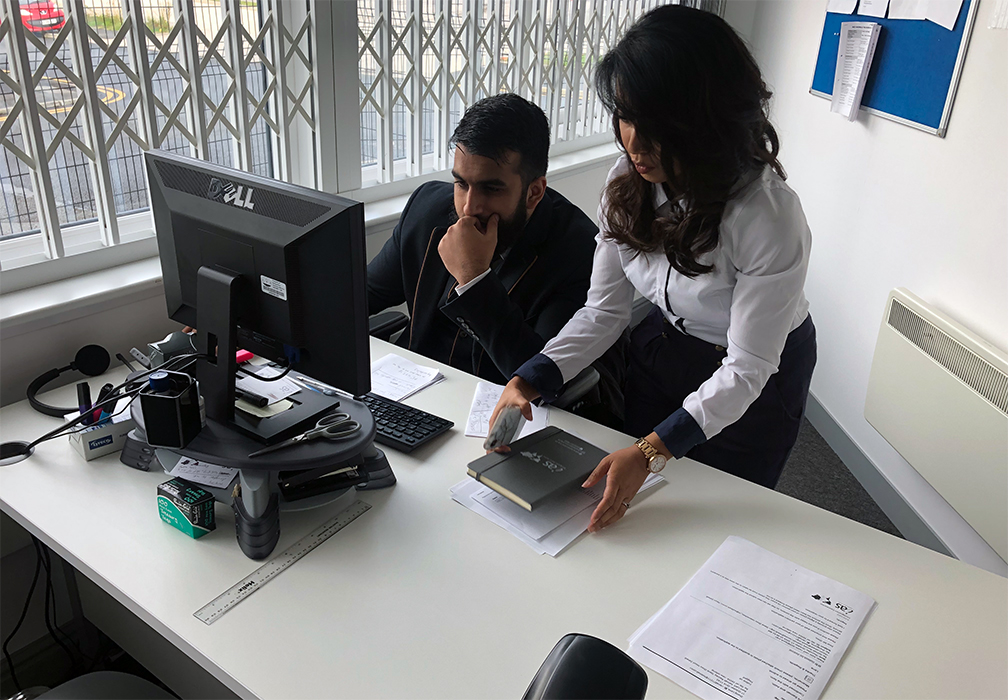
The Fast Track Package
Our Fast-Track Application Package gives your case priority with our immigration lawyers, helping you get your application prepared, checked and submitted as quickly as possible.
Your case receives priority handling, including accelerated document reviews, application preparation, communication with your caseworker and submission support.

The Appeal Package
Our immigration lawyers will review the decision, explain why it was refused and advise on the strongest option available to you, including an appeal, review or fresh application where appropriate.
We will examine the reasons for refusal, identify weaknesses or errors, assess your available options and provide the legal support and representation your case requires.
Related pages for your continued reading.
Frequently Asked Questions
Only in specific circumstances. An H4 spouse must separately qualify for and obtain employment authorization, which is available in most cases where the H1B worker has an approved I-140 immigrant petition or has been granted an extension beyond the standard six-year limit under the American Competitiveness in the Twenty-First Century Act. Without independent work authorization, an H4 spouse cannot accept employment.
Dependents typically retain valid status as long as the principal worker maintains valid H1B status through the new employer’s petition, though it is advisable to file or update the dependents’ own status paperwork to reflect the change and avoid any gap in documentation.
Yes. Petitions filed by institutions of higher education, nonprofit organizations affiliated with a university, and nonprofit or governmental research organizations are exempt from the annual numerical cap and are not subject to the lottery, allowing these employers to file at any time during the year.
Yes, provided the position and wage attestation reflect the actual part-time schedule and the role still meets the specialty occupation standard. The wage obligation under the Labor Condition Application applies proportionally to the hours specified in the petition.

Clear, professional guidance.
Get clear, professional guidance for your immigration case.
Call Now Call To Discuss